

Directions for use
1 - Loading the Goff-Bol™ Max Applicator
Slide the pin from the applicator to the outward position.
Insert two boluses.

2 - Positioning (figure 1)
If you are right-handed, place yourself on the cow’s right side, using your left knee for leverage under the cow’s head.
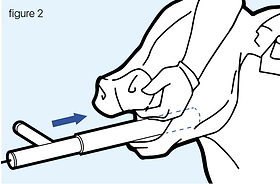
3 - Applicator Insertion (figure 2 & 3)
Grab the cow’s upper jaw with your left hand and gently glide the Goff-Bol™ Max Applicator into the cow’s mouth. Guide the applicator into the cow’s mouth until the handle is in the corner of the mouth (over the tongue).
Do not use force - let the cow allow you to insert the applicator.


4 - Releasing the First Bolus
When the applicator is properly inserted, slide the pin inward to release the first bolus. Allow a few seconds to swallow.

5 - Releasing the Second Bolus
Turn the pin clockwise to align the keyhole and slide pin forward to release second bolus.

6 - Applicator Removal
Wait a moment for the cow to swallow and gently remove applicator. Allow access to water.

WARNING
Incorrect use of the applicator may result in the injury and/or death of the animal. Do not use the applicator unless you are appropriately trained. Inspect applicator for wear/damage prior to use. A damaged or worn applicator should not be used. Ensure the applicator is being used on the correct bolus and type of animal being treated.
Best Practices to Improve Transition Cow Success
1) Decrease social stress by housing heifers and cows separately, minimizing pen moves, and reducing over-stocking.
2) Monitor and address clinical and subclinical hypocalcemia in multiparous cows to reduce secondary diseases.
3) Feed cows and heifer different diets prepartum.
4) Optimize DMI prepartum by feeding multiple times daily, pushing up feed frequently, and providing adequate bunk space. 5) Calve cows in dry clean bedded pack, and train employees in gentle methods to deliver calves.
6) Use Goff-Bol™ Max and formulate a prepartum diet low in potassium, low in phosphorus, and high in magnesium.